Ben Uri Collection

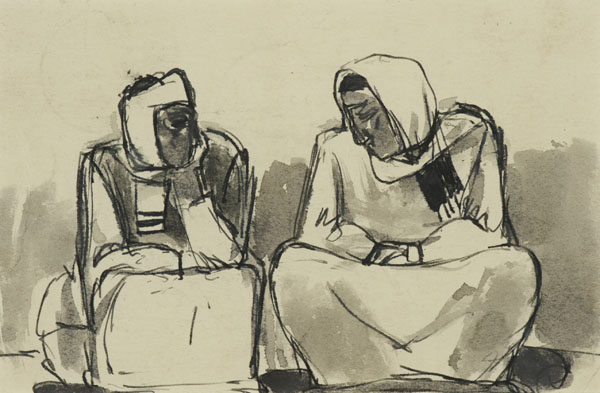
Two Seated Figures
Artist information
Born Warsaw, Poland
Died London, England
Find more work in the collection by this artist
Find out more about this artist
Painter and draughtsman Josef Herman was born into a Jewish, working-class family in Warsaw, Poland on 3 January 1911. He studied at the Warsaw School of Art and Decoration (1930-31), and first exhibited in his native city in 1932. Following increasing anti-Semitism, he left Poland for Brussels in 1938, where he was inspired by the Belgian Expressionists. With the onset of the Second World War, he was forced to flee via southern France and arrived in Glasgow in 1940, where he was reunited with fellow Polish artist Jankel Adler, whom he had known briefly in Warsaw. Together the two artists contributed, together with Scottish Colourist J D Fergusson, to a resurgence of the Scottish arts scene during this period. Herman moved briefly to London in 1943, exhibiting at the Lefevre Galleries, London (with L S Lowry, 1943) prior to his relocation to the Welsh mining village of Ystradgynlais (1944-55), which gave rise to his best-known body of work focusing on the Welsh miners and their community. In 1951 he was included in the South Bank Festival of Britain Exhibition and continued to exhibit widely including with the émigré art dealers Roland, Browse & Delbanco (1946, 1948, 1952, then regularly until 1975), in London, with Ben Uri (including alongside Martin Bloch in 1949), at the Geffrye Museum (with Henry Moore, 1954), the Whitechapel Art Gallery (1956) and Camden Arts Centre (1980), as well as at the National Museum of Wales, Cardiff (1989), Abbot Hall, Kendal (2005), and many further exhibitions with Flowers and Flowers East Galleries, who represented him for many years.
Josef Herman died in London, England on 19 February 2000. His work is represented in numerous UK public collections including London (Tate, V&A), Wales (National Museum), Scotland (Scottish National Gallery of Modern Art); as well as in Canada, Australia, Israel, South Africa and New Zealand. An exhibition exploring his early years in Warsaw, Brussels, Glasgow and London, 1938-43 was held at Ben Uri Gallery in 2011.
Object Details
Date 1952
Object type drawing
Medium pen and ink and wash on paper
Materials and techniques ink | pen (medium) paper (support)
Unframed 9.5 x 14.5 cm
Framed 23 x 26.7 cm
Acquisition Presented by Gustav Delbanco 1988
Accession number 1988-24i
Display status not on display
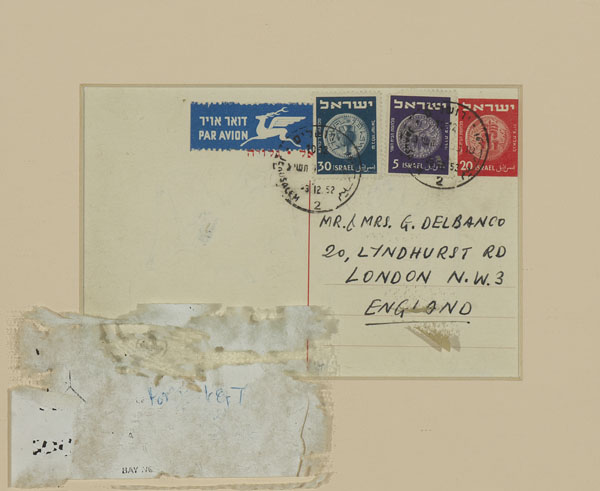
This image was made on the front of a postcard during Herman's two-and-a-half month visit to Israel at the end of 1952. The artist later recalled that he could not stop drawing and produced over 200 drawings in ten weeks, many of them of the Kibbutzniks. The strong, earthy figures and monumental forms show Herman's respect for those who worked the land.
This postcard was donated by the addressee, Gustav Delbanco, one of the three eponymous gallerists of Roland, Browse and Delbanco, established in London’s Cork Street by Henry Roland (né Heinz Rosenbaum) and Gustav Delbanco, both refugees of German-Jewish origin, together with Lilian Browse, in 1945. Herman had his first solo show there in 1946 and went on to exhibit with them for almost 30 years. They also exhibited a number of other émigré artists postwar including Jankel Adler, Alfred Cohen, Heinz Inlander and Katerina Wilczynski.
Keywords
drawing | figure study | Israel | kibbutzniks
Selected exhibition history
1989
Prints and Sculpture from the Permanent Collection and Recent Acquisitions
Ben Uri Art Gallery
1990
Jankel Adler and Josef Herman: Paintings, drawings, watercolours
Compass Gallery
2024
Cosmopolis: The Impact of Refugee Art Dealers in London
Ben Uri Gallery
Literature
Walter Schwab and Julia Weiner, eds., Jewish Artists: the Ben Uri Collection - Paintings, Drawings, Prints and Sculpture (London: Ben Uri Art Society in association with Lund Humphries Publishers Ltd, 1994), p. 127.
Hover mouse cursor over image to zoom (you can also use the mouse wheel).
To license this image contact Bridgeman images
Related works
Postcard
by Josef Herman