Ben Uri Collection

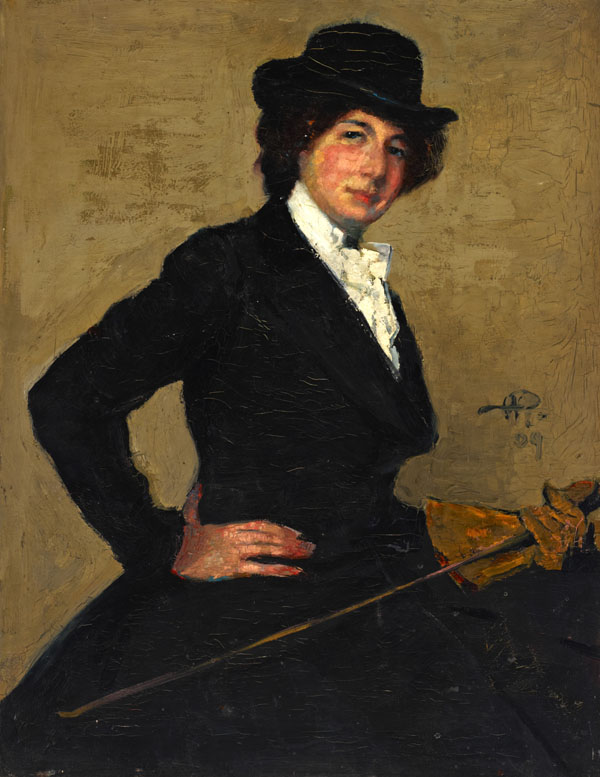
Portrait of Mrs Ethel Solomon in Riding Habit
Artist information
Name Alfred Wolmark (1877-1961)
Born Warsaw, Poland
Died London, England
Find more work in the collection by this artist
Find out more about this artist
Aaron Wolmark was born into a Jewish family in Warsaw, Poland on 28 December 1877, and moved to England with his family in 1883, first to Devon and then to the East End of London. He trained at the Royal Academy (from 1895), where he added the English 'Alfred' to his name, exhibiting there (1901–36), as well as with the Allied Artists Association (1908–16) and the International Society (1911–25). He had his first solo exhibition at Bruton Galleries in London (1905). Wolmark's teenage years in London’s East End and two lengthy stays in his native Poland between 1903–6, had a huge visual and spiritual, impact on his early Rembrandtesque work and Jewish subject matter.
In July 1911, after an artistic epiphany on honeymoon in Concarneau, Brittany, Wolmark jettisoned his early methods in favour of the ‘New Art’ and embarked upon the pioneering 'colourist' path that he followed for the next two decades of his working life. A pioneer as a painter of both the Jewish community in London’s East End and as an early modernist, Wolmark has been called the ‘father’ of the Whitechapel Boys. He was the only artist to be included in both the Whitechapel Art Gallery’s 1906 'Jewish Art and Antiquities Exhibition' and in David Bomberg and Jacob Epstein's 'Jewish Section' at the 1914 exhibition 'Twentieth-Century Art: A Review of Modern Movements'.
Wolmark exhibited regularly with the Ben Uri Art Society, as well as at the Grafton (1911, 1916, 1917) and Whitechapel Galleries (1910, 1914, 1927, 1956). In 1915 he co-founded the JAAS (Jewish Association of Arts and Sciences) with Adrian Alfred Woolfstein (Adrian Wolfe). Closely associated with the Ben Uri for many years: in 1925, together with Solomon J Solomon, Wolmark presided over the official opening of the Ben Uri’s first gallery in Great Russell Street, also acting as Vice-President from 1923–56, and as an adviser on purchasing policy. In the 1930s he introduced Cyril Ross and Ethel Solomon (Mrs Robert Solomon) to the Society. His oeuvre also included theatre designs for two Diaghilev ballets, pottery and stained-glass windows. Despite his success, Wolmark was rejected from both the London Group (1914) and the Royal Academy (1938). He died in London, England on 6 January 1961. His work is in many UK collections including the Arts Council Collection, the Ferens Art Gallery, the Government Art Collection, the Jerwood Collection, Middlesbrough Institute of Modern Art (MIMA), the National Portrait Gallery, Southampton City Art Gallery and The Stanley and Audrey Burton Gallery at the University of Leeds.
Object Details
Date 1909
Object type painting
Medium oil on canvas
Materials and techniques oil (medium) painting (technique) canvas (support)
Unframed 92 x 71.5 cm
Framed 103 x 83 cm
Signed (centre right) with monogram and dated ‘09’
Acquisition on loan from the family of Mrs Ethel Solomon 1988
Accession number 1988-59
Display status not on display
Born in Edgbaston, the daughter of a draper, Mrs Ethel Solomon (née Cohen, 1888–1985), went on to become a highly influential figure as Chair of the Women’s Federation of British Zionists (1920) and as co-founder with her husband, Robert, of Whittingehame Farm School, founded in 1939 to educate German and Austrian refugee children. It was Alfred Wolmark who introduced her to Ben Uri and she was invited to join the Committee in 1933; between c. 1943 and 1966, she was Chair and helped to safeguard the collection during the Second World War. Under her Chairmanship, the Society's activities greatly expanded to include not only lectures but also art classes, drama and music. She was introduced to the painter Alfred Wolmark by her mother, Mrs. Herbert Cohen, whose portrait Wolmark also painted.
Using a bold, loose paint handling, Wolmark shows Ethel Solomon as a fashionable young woman in black-and-white riding attire, offset by her mustard-yellow gloves, the putty-coloured background emphasising her fresh complexion. The portrait shows Wolmark at a key transitional moment between his early Rembrandtesque manner and dark palette, anticipating his notable conversion to colour after 1911. He also uses the dramatic pose as a compositional device to indicate his sitter’s strong character. The portrait, signed with an early version of his trademark monogram, relates to his later series of single-figure works including 'The Fencer' (c. 1914, current whereabouts unknown), which repeats the emphatic hand-on-hip gesture, and the 'Portrait of Dottie Konstam' (aka Mrs Alfred Kohnstamm, 1915, Private Collection), in which his female subject holding her parasol echoes the strong diagonal of Mrs Solomon grasping her riding crop. Wolmark executed many portraits of Jewish sitters including the head of the writer Israel Zangwill (1925, Ben Uri Collection), Ben Uri's first President from 1921–24, who was known as the ‘Jewish Dickens’.
Keywords
Selected exhibition history
1934
The Opening of the Ben Uri Jewish Art Gallery and an Exhibition of Works by Jewish Artists
Ben Uri Jewish Art Gallery
1944
Opening Exhibition
Ben Uri Art Gallery
1961
Alfred Wolmark, 1867-1961, Memorial Exhibition of Paintings
Ben Uri Art Gallery
1989
Prints and Sculpture from the Permanent Collection and Recent Acquisitions
Ben Uri Art Gallery
2009
Homeless & Hidden 1: World Class Collection Homeless & Hidden
Ben Uri Gallery
2015
Out of Chaos – Ben Uri: 100 Years in London
Somerset House
2024
US: From There to Here - Britain's Gain
Ben Uri Gallery and Museum
Literature
Rachel Dickson and Sarah MacDougall, eds., Out of Chaos: Ben Uri; 100 Years in London (London: Ben Uri Gallery, 2015) pp. 36-37.; Oil Paintings in Public Ownership in Camden (London: The Public Catalogue Foundation, 2013) p. 44; Walter Schwab and Julia Weiner, eds., Jewish Artists: the Ben Uri Collection - Paintings, Drawings, Prints and Sculpture (London: Ben Uri Art Society in association with Lund Humphries Publishers Ltd, 1994), p. 157.
Hover mouse cursor over image to zoom (you can also use the mouse wheel).
To license this image contact Bridgeman images
Related works
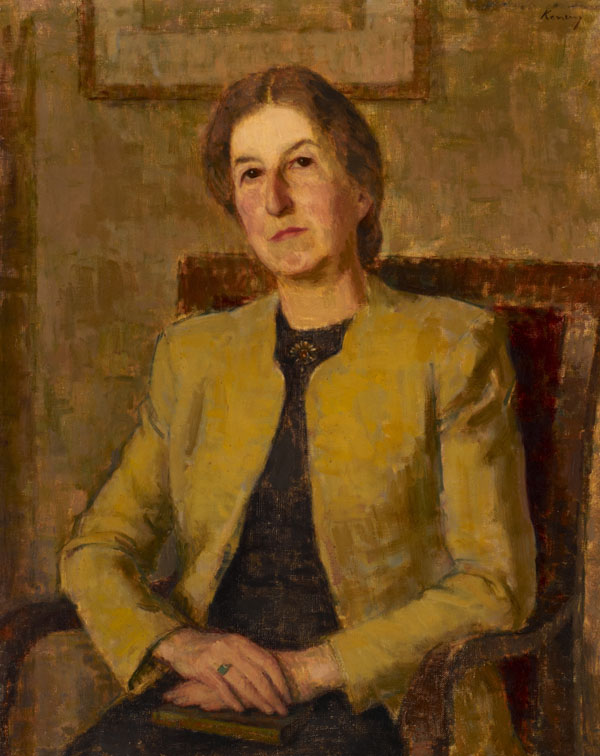
Portrait of Mrs Robert Solomon
by Kalman Kemeny
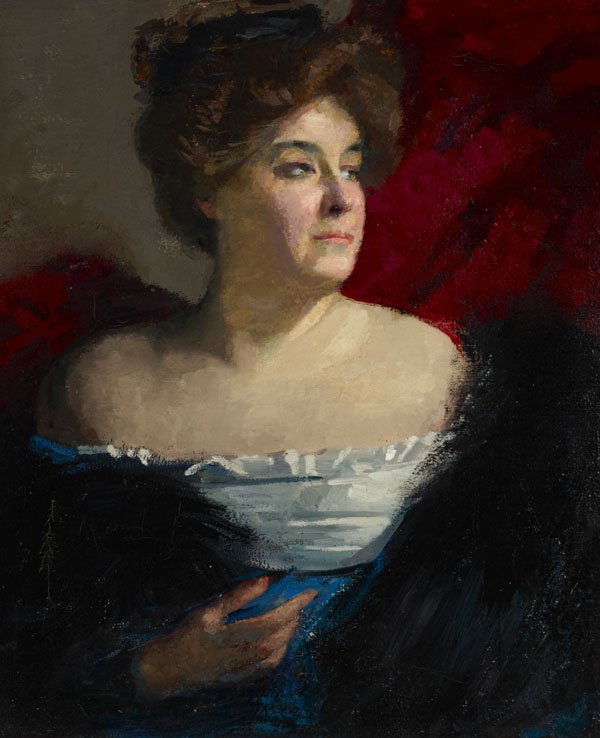
Portrait of Mrs Herbert Cohen
by Alfred Wolmark