Ben Uri Collection

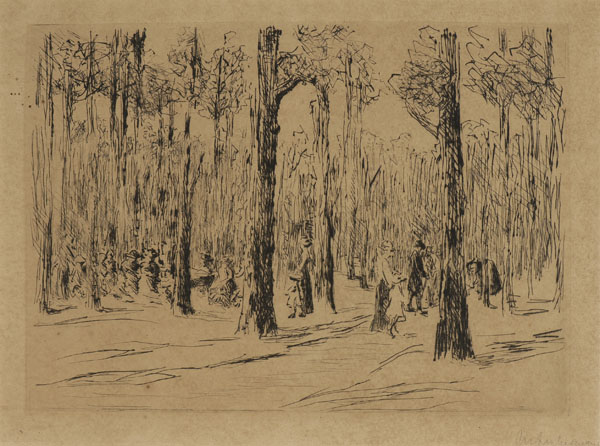
Woods at Scheveningen
Artist information
Name Max Liebermann (1847-1935)
Born Berlin, Germany
Died Berlin, Germany
Find more work in the collection by this artist
Find out more about this artist
Born into a Jewish family in Berlin, Germany on 20 July 1847, Max Liebermann spent a formative period in Paris, then moved to Munich in 1878, before returning to Berlin in 1884. He became a leading figure in German Impressionism and was one of the founders of the Berlin Secession in 1889, of which he also became the first President. A decade on, as one of the dominant figures in the German art scene, he was considered one of the establishment figures against whom the German Expressionists revolted. In 1920 Liebermann was appointed president of the Prussian Academy of Art, the highest artistic institution of the Weimar Republic, but after the Nazis came to power in Germany in 1933, Liebermann was obliged to resign. In June 1934 seven of his works were included in the 'Exhibition of German-Jewish Artists' Work' organised at the Parsons Gallery, London by German-Jewish emigre dealer, Carl Braunschweig (Charles Brunswick), championing artists suffering persecution under the Nazi regime. Liebermann spent his final two years in isolation and died in Berlin, Germany on 8 February 1935.
In 1940 the Nazis took possession of Liebermann's villa and studio in the Berlin suburb of Wansee. Two years later, on 20 January 1942, senior officials gathered in the house next door to implement the so-called Final Solution to 'the Jewish question'. Liebermann's widow, Martha, survived until 1943, when fearing Gestapo interrogation, she committed suicide. Since 2006, the Liebermann villa has been open to the public and houses an art museum dedicated to Liebermann’s life and work, which is also held in many international collections. Liebermann also amassed an important collection of Impressionist paintings, later confiscated from German museums by the Nazis, many of which - along with his own works - have been subject to restitution claims.
Object Details
Object type print
Medium etching on paper
Materials and techniques ink (medium) etching (technique) paper (support)
Unframed 22 x 29.3 cm
Framed 43.2 x 54.1 cm
Signed (lower right): 'Max Liebermann'
Acquisition Bequest by Stephanie Ellen Kohn in memory of her parents Franz and Margarethe Kohn (nee Schotlander) and her brother Ludwig who perished in the Holocaust
Accession number 1990-5
Display status not on display
Between 1870 and 1914, although predominantly based in Berlin, Liebermann regularly travelled to the Netherlands to sketch people at work and leisure, later using the sketches to produce paintings and prints in his studio back home. The following etching depicts the crowds resting and strolling through the woods in Scheveningen, one of the coastal districts of Hague, where Liebermann spent a number of summers, frequently in the company of his life-long friend, Dutch painter Josef Israels and the latter’s son Isaac, also an artist. Here, Liebermann masterfully renders a fleeting impression of a busy outdoor scene through a laborious and technically complex etching medium, achieving a degree of liveliness akin to an ink drawing.
Literature
Walter Schwab and Julia Weiner, eds., Jewish Artists: the Ben Uri Collection - Paintings, Drawings, Prints and Sculpture (London: Ben Uri Art Society in association with Lund Humphries Publishers Ltd, 1994), p. 137.