Ben Uri Collection

Miners
Artist information
Born Warsaw, Poland
Died London, England
Find more work in the collection by this artist
Find out more about this artist
Painter and draughtsman Josef Herman was born into a Jewish, working-class family in Warsaw, Poland on 3 January 1911. He studied at the Warsaw School of Art and Decoration (1930-31), and first exhibited in his native city in 1932. Following increasing anti-Semitism, he left Poland for Brussels in 1938, where he was inspired by the Belgian Expressionists. With the onset of the Second World War, he was forced to flee via southern France and arrived in Glasgow in 1940, where he was reunited with fellow Polish artist Jankel Adler, whom he had known briefly in Warsaw. Together the two artists contributed, together with Scottish Colourist J D Fergusson, to a resurgence of the Scottish arts scene during this period. Herman moved briefly to London in 1943, exhibiting at the Lefevre Galleries, London (with L S Lowry, 1943) prior to his relocation to the Welsh mining village of Ystradgynlais (1944-55), which gave rise to his best-known body of work focusing on the Welsh miners and their community. In 1951 he was included in the South Bank Festival of Britain Exhibition and continued to exhibit widely including with the émigré art dealers Roland, Browse & Delbanco (1946, 1948, 1952, then regularly until 1975), in London, with Ben Uri (including alongside Martin Bloch in 1949), at the Geffrye Museum (with Henry Moore, 1954), the Whitechapel Art Gallery (1956) and Camden Arts Centre (1980), as well as at the National Museum of Wales, Cardiff (1989), Abbot Hall, Kendal (2005), and many further exhibitions with Flowers and Flowers East Galleries, who represented him for many years.
Josef Herman died in London, England on 19 February 2000. His work is represented in numerous UK public collections including London (Tate, V&A), Wales (National Museum), Scotland (Scottish National Gallery of Modern Art); as well as in Canada, Australia, Israel, South Africa and New Zealand. An exhibition exploring his early years in Warsaw, Brussels, Glasgow and London, 1938-43 was held at Ben Uri Gallery in 2011.
Object Details
Date c. 1946
Object type drawing
Medium pen and black ink on paper
Materials and techniques ink | pen (medium) paper (support)
Unframed 20x 25 cm
Framed 41.9 x 46.4 x 2 cm
Acquisition presented by Rose and Bernard Gillinson 1991
Accession number 1991-1
Display status not on display
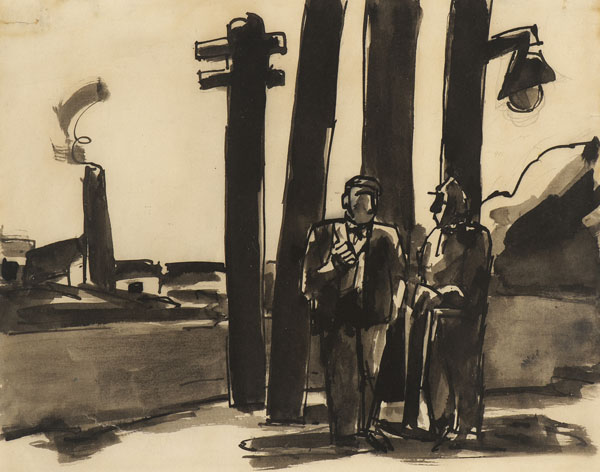
Josef Herman discovered his mature artistic voice after visiting the Welsh village of Ystradgynlais in the summer of 1944, when he saw a group of miners returning from work briefly outlined on a bridge against a copper-coloured sky. That image stayed with him and the miners became an enduring source of inspiration as he lived among them for the next eleven years. He was swiftly accepted into the community and nicknamed 'Joe Bach', and the work he produced made his name in Britain. Herman did not paint the miners at work in the pit but often leaving work and returning home, exhausted after their labours. More often than not, they are anonymous, and represent the universal rather than the particular: they stand for the dignity of labour. Here two upright figures stand in conversation, their figures echoing the vertical forms of the telegraph poles and smoking chimney beyond.
Keywords
drawing | figure study | miners | Wales
Selected exhibition history
2009
Homeless & Hidden 2: World Class Collection Homeless & Hidden
Ben Uri Gallery
2023
Josef Herman: Artistiaid Ffoadur Cymru - Refugee Artists
Hay Castle
2024
US: From There to Here - Britain's Gain
Ben Uri Gallery and Museum
Literature
Sarah MacDougall ed., 'Refiguring the 50s: Joan Eardley, Sheila Fell, Eva Frankfurther, Josef Herman, L S Lowry' (London: Ben Uri, 2014), p. 113 (illus. included); Walter Schwab and Julia Weiner, eds., Jewish Artists: the Ben Uri Collection - Paintings, Drawings, Prints and Sculpture (London: Ben Uri Art Society in association with Lund Humphries Publishers Ltd, 1994), p. 127.
Hover mouse cursor over image to zoom (you can also use the mouse wheel).