Ben Uri Collection

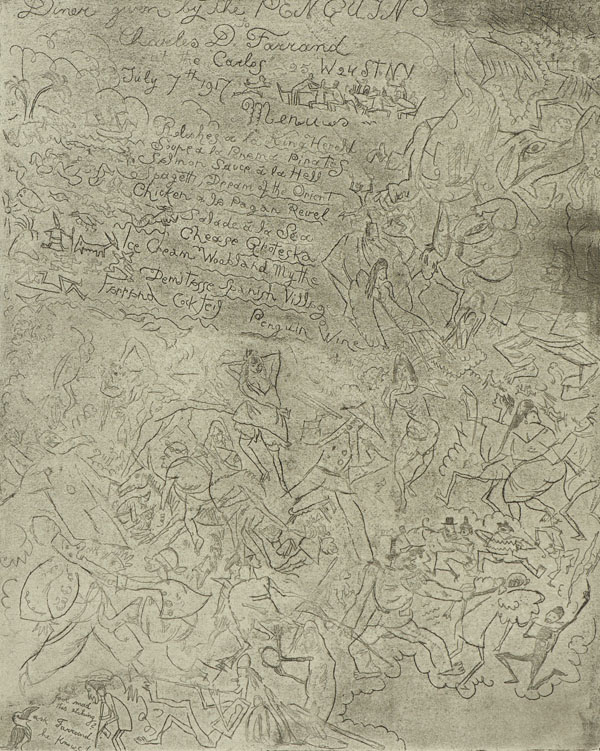
Menu for the Penguin Club II
Artist information
Other name Julius Mordecai Pincas
Born Vidin, Bulgaria
Died Paris, France
Find more work in the collection by this artist
Find out more about this artist
Painter and draughtsman Jules Pascin (né Julius Mordecai Pincas) was born into a Sephardic Jewish family in Vidin, Bulgaria on 31 March 1885 and raised in Bucharest, Romania. His earliest drawings were made surreptitiously in a local brothel. The female body remained a constant throughout his artistic career: casually posed, nude or partially dressed. Pascin was educated in Vienna and Munich and moved to Paris in 1905, contributing to the German satirical magazine Simplicissimus. His first paintings demonstrated the influence of the French Post-impressionist school and the Fauves. Despite exhibiting at the Salon d’Automne and Salon des Indépendents, Pascin became depressed over his lack of critical success and enrolled at the Académie Colarossi in Paris, spending hours copying Old Masters in the Louvre.
During the First World War, he avoided military service by moving first to London upon its outbreak in August, then to America in October 1914. There, Pascin was part of the artists’ circle based around the Penguin Club, set up by Walter Kuhn in 1916 in a modest East 15th Street brownstone. It hosted weekly drawing classes, exhibitions and an annual ball. In 1920 he returned to France and became closely associated with the École de Paris circle of Chagall, Modigliani and Soutine.
Tormented by depression and alcoholism, Pascin took his own life on the eve of his first solo exhibition in Paris, France on 1 June 1930. Following the rise of Nazism, Pascin was officially labeled a 'degenerate' artist by the Nazi regime, and his work was included in the notorious Entartete Kunst (Degenerate Art) exhibition of 1937. During this period, 17 of his works were confiscated from German museums and public collections as part of the Nazis' systematic purge of modern art.
Today, in the UK his work is represented in the Ben Uri Collection, the Sainsbury Centre for Visual Arts and Southampton City Art Gallery, as well as in numerous collections in France and the USA.
Object Details
Date 1917
Object type print
Medium etching on paper
Materials and techniques ink (medium) paper (support)
Unframed 23.5 x 19 cm
Framed 44.5 x 38 cm
Acquisition presented by Barry and Anne Fealdman 1993
Accession number 1993-27
Display status not on display
Pascin settled in New York in 1914, after the outbreak of the First World War, remaining until 1920. In New York, Pascin was part of the artists’ circle based around the Penguin Club. Set up by Walter Kuhn in 1916 in a modest East 15th Street brownstone, it hosted weekly drawing classes, exhibitions and an annual ball. Pascin’s playful menu commemorates a meal at Carlos restaurant on 7th July 1917, combining vignettes of people and animals with an inventive menu including Penguin wine, spaghetti ‘Dream of the Orient’ and ‘cheese groteska’. Brodzky had a solo show at the Penguin Club in 1918 and produced a similarly carnivalesque etching, Penguin Stag, the same year.
Keywords
Selected exhibition history
2017
Entartete Kunst (“Degenerate Art”) Remembered
Ben Uri (Online)
2019
Mark Gertler: Paintings from the Luke Gertler Bequest & Selected Important UK Collections
Ben Uri Gallery
Literature
Walter Schwab and Julia Weiner, eds., Jewish Artists: the Ben Uri Collection - Paintings, Drawings, Prints and Sculpture (London: Ben Uri Art Society in association with Lund Humphries Publishers Ltd, 1994), p. 143.
Hover mouse cursor over image to zoom (you can also use the mouse wheel).