Ben Uri Collection

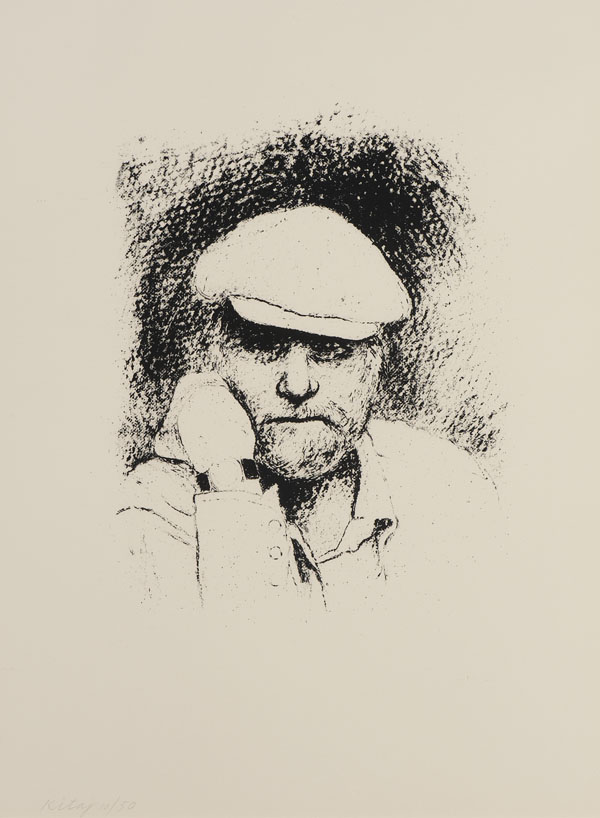
Self-Portrait in Flat Cap
Artist information
Other name Ronald Brooks Kitaj
Born Cleveland, Ohio, USA
Died Los Angeles, California, USA
Find more work in the collection by this artist
Find out more about this artist
Painter, printmaker and draughtsman R. B. (Ronald Brooks) Kitaj was born to a Hungarian father and an American mother (of Russian-Jewish immigrant parentage) in Cleveland, Ohio, USA on 29 October 1932. After his parents divorced, his mother married Walter Kitaj, a Viennese-Jewish refugee and research chemist, and Kitaj took his stepfather's name. Following an early career as a merchant seaman, he studied painting at the Academy of Fine Arts in Vienna and at Cooper Union in New York. He served in the US army for two years, travelling widely in France and Germany, before moving to England to complete his training at the Ruskin School of Art in Oxford (1958-59) and the Royal College of Art, London (1959-61), alongside David Hockney, Derek Boshier, Allen Jones and Patrick Caulfield, among others. His first solo exhibition was held at Marlborough Fine Art, London in 1963 and his early work, executed in bright, flat colours was associated by some critics with the Pop Art Movement, a label he rejected. In his later years (particularly after his second marriage to fellow painter Sandra Fisher), he made numerous works exploring his Jewish identity. During the 1960s Kitaj taught at Ealing Art College, Camberwell School of Art and the Slade School of Fine Art, and latterly, at the University of California, Berkeley in 1968. In 1976 he selected work by a group of British figurative painters, whom he famously described as representing a 'School of London' for an important exhibition entitled 'The Human Clay', organised by the Arts Council of Great Britain and held at the Hayward Gallery, London. This much-debated term has come to apply to a fixed group including Michael Andrews, Frank Auerbach, Francis Bacon, Lucian Freud and Leon Kossoff, as well as Kitaj himself, although the term was not accepted by many of its so-called members.
In 1982 Kitaj was elected to the American Academy of Arts and Letters and he became a Royal Academician in 1985. Following a sharply critical response to his 1994 Tate exhibition however, and the sudden death of his wife, Sandra, only weeks after its opening, Kitaj relocated permanently to Los Angeles in 1997. Debilitated by Parkinson’s disease in his later years, he committed suicide in Los Angeles, USA on 21 October 2007. In 2001 an important exhibition of his work was held at the National Gallery, London. His work is represented in numerous UK collections including the Ben Uri Collection, the British Council Collection, Pallant House Gallery, Tate, the Yale Center for British Art, and the Whitworth, as well as international collections including MoMA, New York.
Object Details
Date c. 1981
Object type print
Medium lithograph on paper
Materials and techniques ink (medium) lithography (technique) cream Arches paper (support)
Unframed 76.5 x 57 cm
Framed 97.2 x 77.3 cm
Signed (lower left): 'KITAJ 10/50'
Acquisition presented by the artist 1993
Accession number 1993-530
Display status not on display
Kitaj executed a number of highly introspective self-portraits including this lithograph in which he wears a flat cap.
Keywords
cap | print | self-portrait
Selected exhibition history
2007
London Senses and Experiences: Art in the Big City - Michael Andrews, Frank Auerbach, Lucian Freud, Ron Kitaj, Leon Kossoff, Euan Uglow
Ben Uri Gallery - The London Jewish Museum of Art
2018
Exodus: masterworks from the Ben Uri Collection
Bushey Museum
2019
Friends and Influences: Auerbach, Freud, Kitaj, Kossoff, Bomberg; Chagall, Soutine, Marevna
Ben Uri Gallery
2025
Born in the USA: USA to UK - American Immigrant Artists' Contribution to British Visual Culture since 1900 from the Ben Uri Collection
Ben Uri Gallery
Literature
David Glasser, 'London Senses and Experiences', 4 July - 5 August 2007 (London, Ben Uri Gallery, 2007); Walter Schwab and Julia Weiner, eds., Jewish Artists: the Ben Uri Collection - Paintings, Drawings, Prints and Sculpture (London: Ben Uri Art Society in association with Lund Humphries Publishers Ltd, 1994), p. 131.
Hover mouse cursor over image to zoom (you can also use the mouse wheel).