Ben Uri Collection

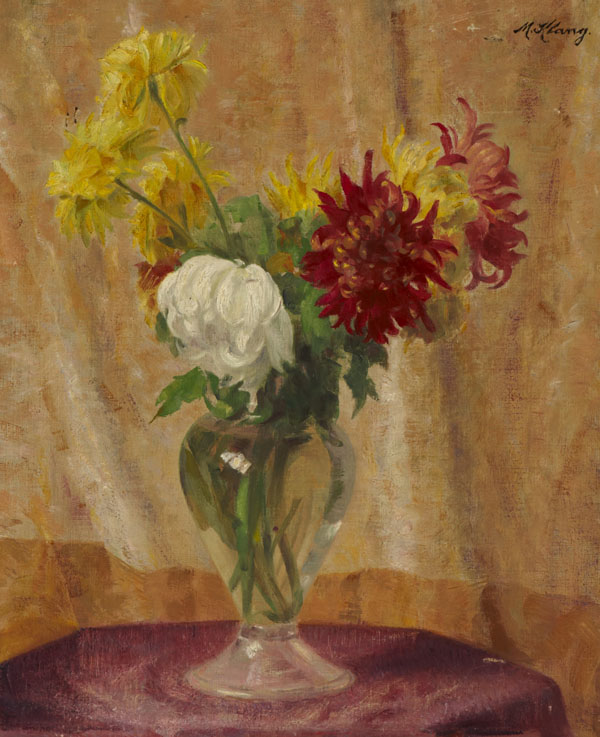
Flowerpiece (recto)
Artist information
Other name Mayer Klang, Myer Klang
Born Lemberg (now Lviv), Galicia, Austro-Hungary
Died London, England
Find more work in the collection by this artist
Find out more about this artist
Painter Meyer (also spelled Mayer or Myer) Klang was born into a Jewish family in Lemberg, Galicia (then part of the Austro-Hungarian empire) in 1880 and moved to Romania with his family at the age of four. He was educated at a Jewish school, then at the age of 16 entered the Munich Academy of Art (1896–1901) in Germany, afterwards returning to Bucharest, exhibiting his first picture at the Art Exhibition at Ileana and also showing in the Bucharest salon, where he won second prize (relegated to third on account of his Jewish origins). Following protests from non-Jewish artists at his proposed inclusion at the Paris Salon, his work was removed and his hopes of professional advancement ended. Together with his family, he immigrated to England in 1902 and lived in London's Jewish quarter in the East End. He was an occasional illustrator for the Jewish World newspaper and in 1902 he produced illustrations for 'Ghetto Types' including 'the Chazan', 'the Shammes', 'the Melammed' and 'the student'. The following year, he appeared on its front page, and his works on exhibition at 195 Kingsland Road, Dalston, including a commissioned portrait of Mr and Mrs John Bird, and a portrait of his wife, was positively reviewed. His other commissioned portrait subjects include Dr. Rev. Adler, Chief Rabbi of the British Empire (presented by the United Synagogue on the Chief Rabbi's 70th birthday) in 1909, and a full-length likeness, 'subscribed for by citizens', of Alderman William Jarman J.P., then Mayor of Hull. Klang’s portrait of fellow painter Ernest Borough Johnson was displayed in the 1932 exhibition of the Royal Society of Portrait Painters; his other sitters included German émigrée sculptor Elsa Fraenkel.
Klang was a member of the Arts Committee of The Jewish Association of Arts and Sciences (J.A.A.S.), based in the East End and was depicted in Adrian Wolfe’s 1917 cartoon (Ben Uri Collection), which shows (left to right): Rebekoff, Adrian Wolfe, Meyer Klang, Isaac Snowman, Alfred Wolmark and Morris Goldstein. Klang was also a member of the short-lived Society of Jewish Artists (1923–25), for which he gave a demonstration of painting in June 1923 that formed one of his exhibits at the Exhibition of Jewish Art at the Whitechapel Art Gallery organised by the Society of Jewish Artists the same year.
Klang participated frequently in mixed exhibitions including at the Royal Academy, in an exhibition of Jewish artists in 1902, and at Ben Uri Gallery (1934–37, 1943–44 and 1951), as well as at the Royal Society of British Arts, and the Walker Art Gallery in Liverpool. In 1927 his work was included in the Exhibition of Jewish Art & Antiquities at the Whitechapel Art Gallery and in 1933 in the British Empire Society of Arts' exhibition. Meyer Klang died in London, England in 1948. In the UK his work is represented in the Ben Uri Collection, The Francis W Reckitt Arts Trust, and Hull Guildhall.
Object Details
Object type painting
Medium oil on canvas
Materials and techniques oil (medium) canvas (support)
Unframed 56 x 46 cm
Signed (upper right): M. Klang
Acquisition presented 1948
Accession number 1987-179i
Display status not on display
Keywords
Literature
Oil Paintings in Public Ownership in Camden (London: The Public Catalogue Foundation, 2013), p.22 (illus. included); Walter Schwab and Julia Weiner, eds., Jewish Artists: the Ben Uri Collection - Paintings, Drawings, Prints and Sculpture (London: Ben Uri Art Society in association with Lund Humphries Publishers Ltd, 1994), p. 59.
Hover mouse cursor over image to zoom (you can also use the mouse wheel).
Related works
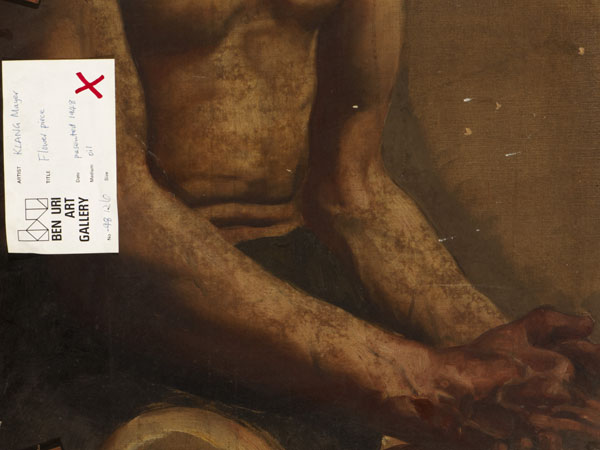
Hands and Torso (verso)
by Meyer Klang
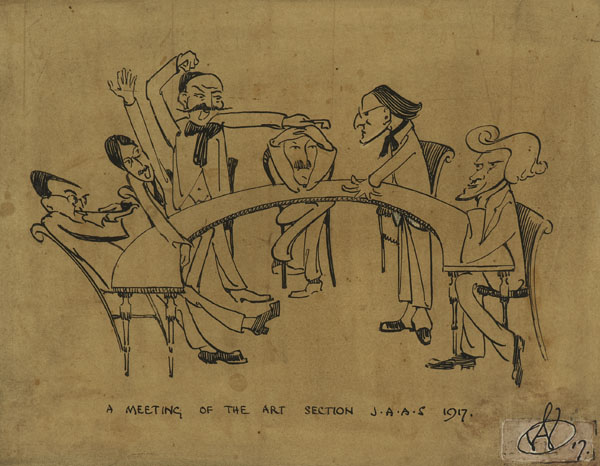
The Arts Committee Meeting
by Alfred Adrian Wolfe