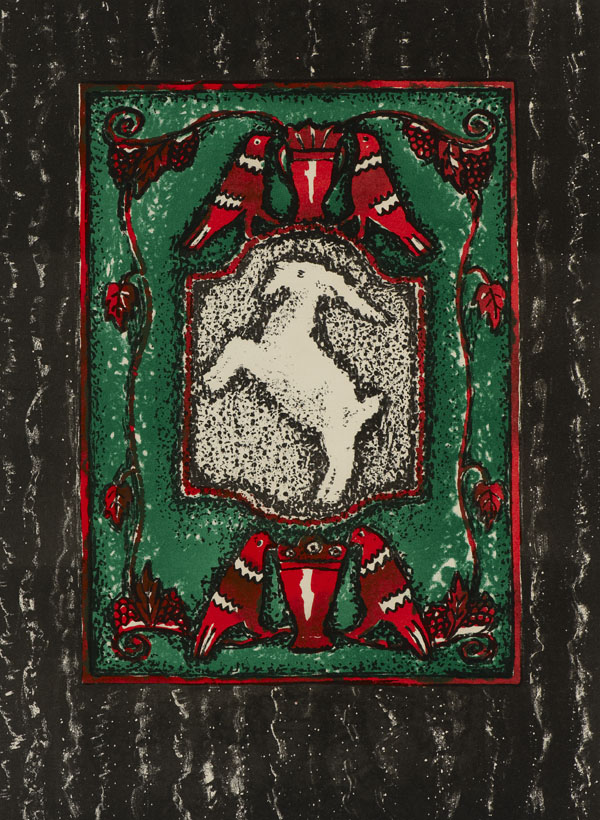
One Kid Goat (Chad Gadya)
Artist information
Name Anatoli Kaplan (1902-1980)
Other name Anatoli Lwowitsch Kaplan
Born Rahachow, Russia (now Belarus)
Died Leningrad (now Saint Petersburg), Russia
Find more work in the collection by this artist
Find out more about this artist
Painter, sculptor and printmaker Anatoli Kaplan was born into a Jewish family in Rahachow, then in the Russian Pale of Settlement (now Belarus) in 1902, the son of a butcher. He moved to Leningrad around 1922, graduating from the Higher Art and Technical Institute, VKhUTEIN (the former Imperial Academy of Arts) in 1927, where he learned the art of printmaking at which he excelled, developing many original techniques. His first cycle of prints, between 1937 and 1940 was entitled 'Kasrilevska', the name of the village invented by the leading Yiddish writer and playwright Sholem Aleichem. Kaplan's second lithographic cycle, Landscapes of Leningrad during the Days of the Blockade (1948), was greeted with great acclaim and bought by 18 state galleries. From the 1950s, Kaplan's art concentrated on Jewish themes, despite obstruction from the Soviet authorities. He lived in Leningrad for the rest of his life but drew on the subject of the towns and shtetls of his childhood, whose characters often appear in his work. Among them are his illustrations to The Bewitched Tailor (1954–57), Sholem Aleichem's Tevye the Milkman (1957–1966), the Song of Songs (1962), Jewish Folk Songs (1962), Dmitri Shostakovich's Jewish Folk Poetry song cycle (1977), and an extensive series of coloured lithographs on the old Jewish Passover song Chad Gadya (One Kid Goat). Throughout this period Kaplan was also producing paintings, which because of their subject matter were rarely displayed in Russia during his lifetime. From 1967 onwards he also made ceramics and sculptures, including a series based on characters from Gogol's Dead Souls. Anatoli Kaplan died in Leningrad (now Saint Petersburg), Russia in 1980, aged 77. His work is represented in international collections including MoMA and there have been major exhibitions of his work in New York, Amsterdam and Jerusalem (1992), followed by an important retrospective at the State Russian Museum in Saint Petersburg in 1995.
Object Details
Date 1961
Object type print
Medium lithograph on paper
Materials and techniques ink (medium) lithography (technique) paper (support)
Unframed 49 x 35.5 cm
Framed 64 x 48.5 cm
Acquisition presented by Dr. Arnold Horwell, 1995
Accession number 1995-3i
Display status not on display
Find out more about this work
Chad Gadya or Had Gadya (Aramaic: חַד גַדְיָא chad gadya, "one little goat, or "one kid"; Hebrew: "גדי אחד gedi echad") is a playful cumulative song in Aramaic and Hebrew, sung at the end of the Passover Seder, the Jewish ritual feast that marks the beginning of the Jewish holiday of Passover. This is one work from an extensive series of coloured lithographs (printed in London in 1961) on the old Jewish Passover song Chad Gadya (One Kid Goat).