Ben Uri collection
Work by Orovida
Biography
Orovida (née Orovida Camille Pissarro) was a second generation émigrée, born into an assimilated Jewish family in Epping, Essex, England on 8 October 1893. A member of the distinguished Pissarro painting dynasty, she was the only daughter of the landscape painter, printmaker, wood engraver, designer and printer Lucien Pissarro (1863–1944) and the wood-engraver, designer, and printer Esther Pissarro (née Bensusan, 1870–1951); she was the granddaughter of Impressionist painter Camille Pissarro (1830–1903). Orovida began drawing and painting at an early age and was the first woman born into the Pissarro family to become a professional artist. She lived and worked predominantly in London, where she was a prominent member of several British arts clubs and societies.
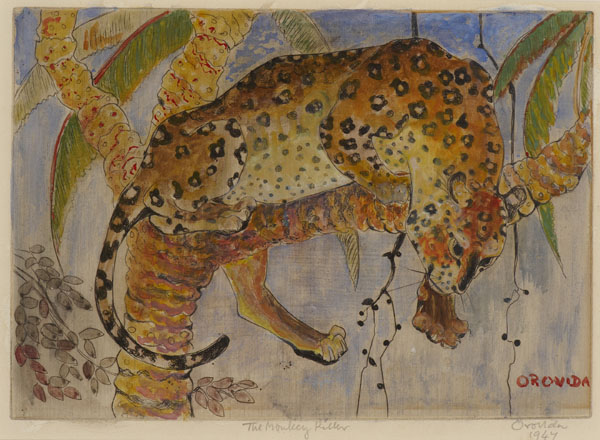
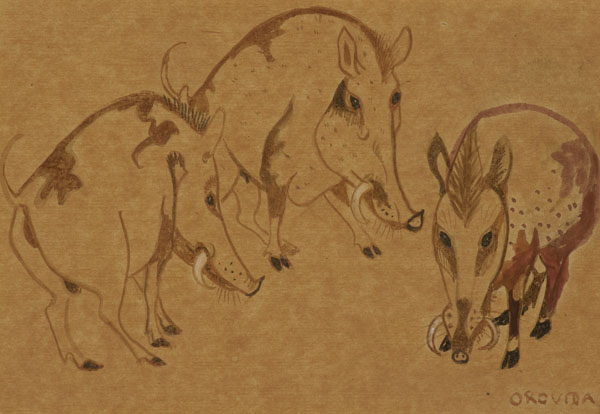
She first learned to paint in the Impressionist style from her father, studying formally only briefly with Walter Sickert in 1913; she began experimenting with etching in 1914, becoming a prolific printmaker and holding a solo exhibition of etchings and drawings at the Adelphi Galleries in 1919. In 1921 she held a joint exhibition with the French artist Marie Laurencin. Throughout her career, Orovida always remained outside mainstream British art movements. She was greatly influenced by an exhibition of Chinese Paintings and Japanese Screens held at the British Museum in 1924 and developed a personal style that combined elements of Japanese, Chinese, Persian, and Indian art. She became absorbed in the study of animals at London Zoo, relating them to the people in their countries of origin. Her rejection of both Impressionism and her surname – she preferred to be known simply as Orovida – reflected her wish to achieve independence from the painting legacy of the Pissarro dynasty, although she remained proud of the connection, and in 1943 participated in an exhibition entitled ‘Three Generations of the Pissarro Family’ (a further show of this name was held posthumously at the Leicester Galleries, London in 1977).
During the Second World War, she took up oil painting and etching due to a deficiency of egg (and hence tempera) and her style changed. She exhibited widely with a number of solo shows at venues including the Redfern Gallery in London. She also exhibited within a Jewish context, participating in the 1923 exhibition of Jewish Art at the Whitechapel Art Gallery and in group exhibitions at Ben Uri Gallery in 1934, 1936, 1937, 1944, 1947, 1951 (twice) and 1956 during her lifetime, as well as posthumously. She was a prominent member of the Women's International Art Club (WIAC), exhibiting in 1921, 1925, 1927-34, 1936-40, 1942, 1944-53, also serving on the executive and hanging committee in 1935, as well as exhibiting regularly at the Royal Academy between 1917 and 1967. She remained active until the end of her life, while also developing and maintaining the Pissarro family archive, established by her parents in the Ashmolean Museum, Oxford.
Orovida Pissarro died in her home in London, England on 8 August 1968. The Ashmolean Museum, Oxford, held a memorial exhibition in 1969. Her works can be found in UK public collections including the Ashmolean Museum, Oxford; the Ben Uri Collection; the London Borough of Camden; Manchester Art Gallery; Portsmouth Museum and the Royal Academy of Arts.
Search Ben Uri archive for more information about Orovida
Artist keywords
London | orientalism | painter | Persian | Pissarro family | Second-generation émigré | tempera | Women's International Art Club
3 work/s by this artist from the collection are shown below. For a more detailed record and image please click on the link.