Ben Uri Pre-Eminent Collection

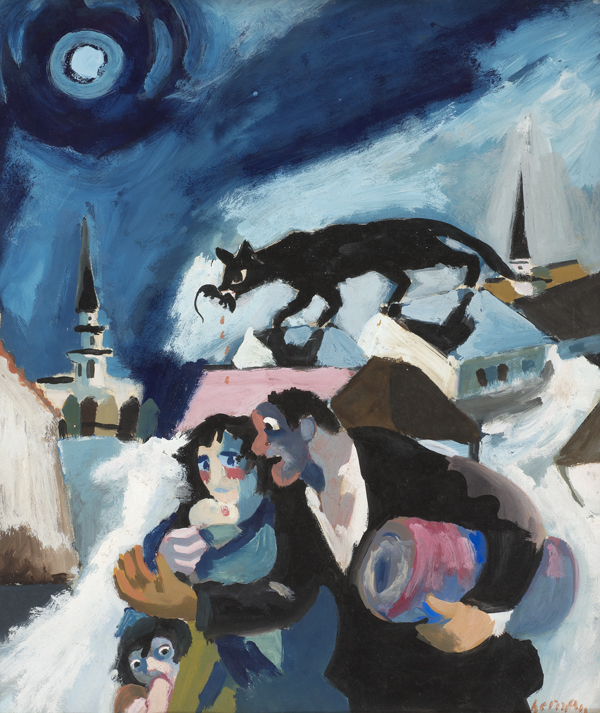
Refugees
Artist information
Born Warsaw, Poland
Died London, England
Find more work in the collection by this artist
Find out more about this artist
Painter and draughtsman Josef Herman was born into a Jewish, working-class family in Warsaw, Poland on 3 January 1911. He studied at the Warsaw School of Art and Decoration (1930-31), and first exhibited in his native city in 1932. Following increasing anti-Semitism, he left Poland for Brussels in 1938, where he was inspired by the Belgian Expressionists. With the onset of the Second World War, he was forced to flee via southern France and arrived in Glasgow in 1940, where he was reunited with fellow Polish artist Jankel Adler, whom he had known briefly in Warsaw. Together the two artists contributed, together with Scottish Colourist J D Fergusson, to a resurgence of the Scottish arts scene during this period. Herman moved briefly to London in 1943, exhibiting at the Lefevre Galleries, London (with L S Lowry, 1943) prior to his relocation to the Welsh mining village of Ystradgynlais (1944-55), which gave rise to his best-known body of work focusing on the Welsh miners and their community. In 1951 he was included in the South Bank Festival of Britain Exhibition and continued to exhibit widely including with the émigré art dealers Roland, Browse & Delbanco (1946, 1948, 1952, then regularly until 1975), in London, with Ben Uri (including alongside Martin Bloch in 1949), at the Geffrye Museum (with Henry Moore, 1954), the Whitechapel Art Gallery (1956) and Camden Arts Centre (1980), as well as at the National Museum of Wales, Cardiff (1989), Abbot Hall, Kendal (2005), and many further exhibitions with Flowers and Flowers East Galleries, who represented him for many years.
Josef Herman died in London, England on 19 February 2000. His work is represented in numerous UK public collections including London (Tate, V&A), Wales (National Museum), Scotland (Scottish National Gallery of Modern Art); as well as in Canada, Australia, Israel, South Africa and New Zealand. An exhibition exploring his early years in Warsaw, Brussels, Glasgow and London, 1938-43 was held at Ben Uri Gallery in 2011.
Object Details
Date c. 1941
Object type painting
Medium gouache on paper
Materials and techniques gouache (medium) painting (technique) paper (support)
Unframed 47 x 39.5 cm
Framed 60.7 x 53.2 x 3.3 cm
Signed and titled on reverse of backing board: 'Refugees by Josef Herman'
Acquisition purchased with the kind assistance of the ACE/V&A Purchase Grant Fund and Art Fund 2014 through Conor Macklin of the Grosvenor Gallery, from the collection of Michael Estorick
Accession number 2014-01
Display status not on display
Refugees is a rare, important early painting, thought lost for over 60 years. Herman destroyed the majority of work from this period in 1948, considering it too influenced by Chagall. Blue was the dominant colour of Herman’s Glasgow years, used as a nostalgic evocation of a lost Warsaw with its moonlit spires. Like much of Herman’s Glasgow work, this painting draws strongly on his eastern European Jewish heritage and themes. However the refugees also represent the wider displacement of peoples uprooted and forced into exile by the upheavals of the Second World War. The family’s unknown fate is symbolized by the cat with a mouse dangling from its jaw, reminiscent of Picasso's Cat Catching a Bird (1939), expressing the helplessnes and anxiety of war. The treatment of the figures reflects Herman’s admiration for Käthe Kollwitz, while the fearful child with her hand in her mouth is reminiscent of Goya's Black paintings.
Selected exhibition history
1942
Exhibition of Paintings by Josef Herman
Aitken Dott & Son
2015
Out of Chaos – Ben Uri: 100 Years in London
Somerset House
2016
Unexpected: continuing narratives of identity and migration
Ben Uri Gallery
2016
100 for 100: Ben Uri Past, Present & Future
Christie's South Kensington
2017
Art Out of the Bloodlands: A Century of Polish Artists in Britain
Ben Uri Gallery
2017
Thirty-six Pounds and Ninety-five Pence: Artworks by Contemporary Migrant Artists
Ben Uri Gallery
2018
Exodus: masterworks from the Ben Uri Collection
Bushey Museum
2018
Acquisitions and Long-Term Loan Highlights Since 2001
Ben Uri Gallery
2018
Wild at Heart: Portrait and self-portrait in Poland after 1989
Zachęta – National Gallery of Art
2019
Brave New Visions: The Emigres Who Transformed the British Art World
Sothebys
2019
Art-exit: 1939 - A Very Different Europe
12 Star Gallery
2019
Migrations: masterworks from the Ben Uri Collection
Gloucester Museum
2022
Refugees from National Socialism in Wales
Aberystwyth Arts Centre
2023
Art, Identity, Migration - Ben Uri at the London Art Fair
Business Design Centre
2023
Refugees from National Socialism in Wales: Learning from the Past for the Future
Senedd Cymru
2023
A Brush with Evil: Peter Howson's Holocaust Crowd Scene II
Ben Uri Gallery
2023
The Second World War on the Home Front (supporting A Brush with Evil II: Laura Knight at the Nuremberg Trial)
Ben Uri Gallery
2023
Josef Herman: Artistiaid Ffoadur Cymru - Refugee Artists
Hay Castle
2024
The Decorative Fair
Evolution London
2025
Always Changing. Always Welcoming: Open-air art exhibition celebrating refugee and immigrant artists’ contribution to British visual culture
Open-air facsimile exhibition outside O2 Centre
2025
Ben Uri 110/25: From Local to Global
Ben Uri Gallery
Literature
Sarah MacDougall (foreword), Important Additions to the Collection since 2000 (London: Ben Uri Gallery and Museum, 2025), p. 8, illus., p. 48; Rachel Dickson, ed., From Adler to Zuławski: A Century of Polish Artists in Britain (London: Ben Uri Research Unit, 2020), pp. 58-59, illus.; Monica Bom-Duchen, ed., Insiders/Outsiders: Refugees from Nazi Europe and their Contribution to British Visual Culture (London: Lund Humphries, 2019), illus., (front cover); Phyllis Lassner, The art of lamentation: Josef Herman’s humanist expressionism (Shofar Journal, Vol. 37, Issue no. 3, 2019), pp. 171-202; Rachel Dickson and Sarah MacDougall, eds., Out of Chaos: Ben Uri; 100 Years in London (London: Ben Uri Gallery, 2015) pp. 94-95; Rachel Dickson and Sarah MacDougall, eds., Ben Uri: 100 Years in London - Art, Identity, Migration (London: Ben Uri Gallery, 2015), p. 2, illus., (detail); Sarah MacDougall, ed., 'Refiguring the 50s: Joan Eardley, Sheila Fell, Eva Frankfurther, Josef Herman, L S Lowry' (London: Ben Uri, 2014), pp. 107-108, illus.
Hover mouse cursor over image to zoom (you can also use the mouse wheel).
To license this image contact Bridgeman images
Related works

Refugees
by Josef Herman
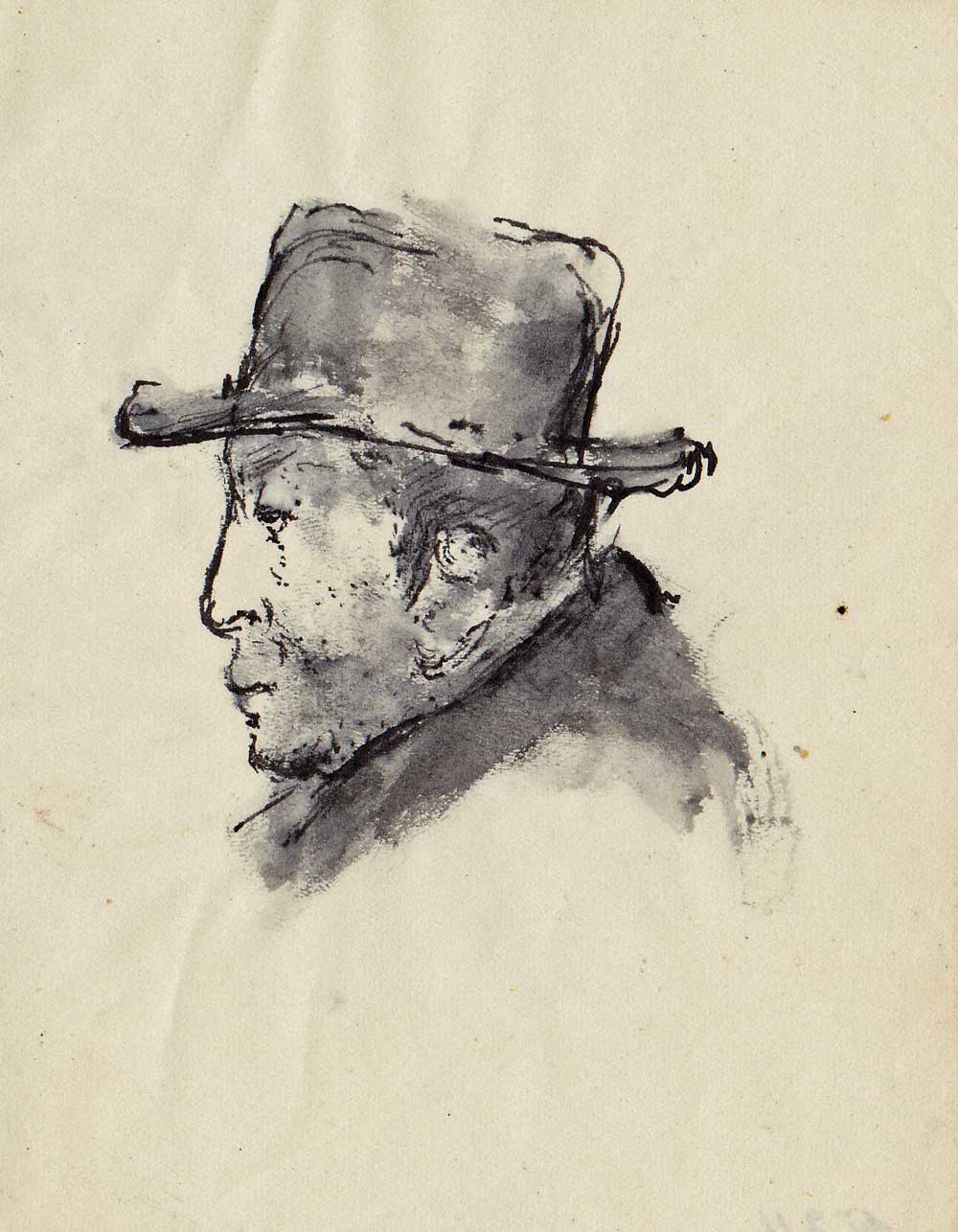
Refugee (aka Man in Hat, Profile Facing Left)
by Eva Frankfurther

Refugees
by Orovida